
Full-Wave Rectification
Full-wave Rectification flips a signal’s negative values to positive. Each negative value becomes its positive equivalent. This is the same as calculating the absolute value of the signal.
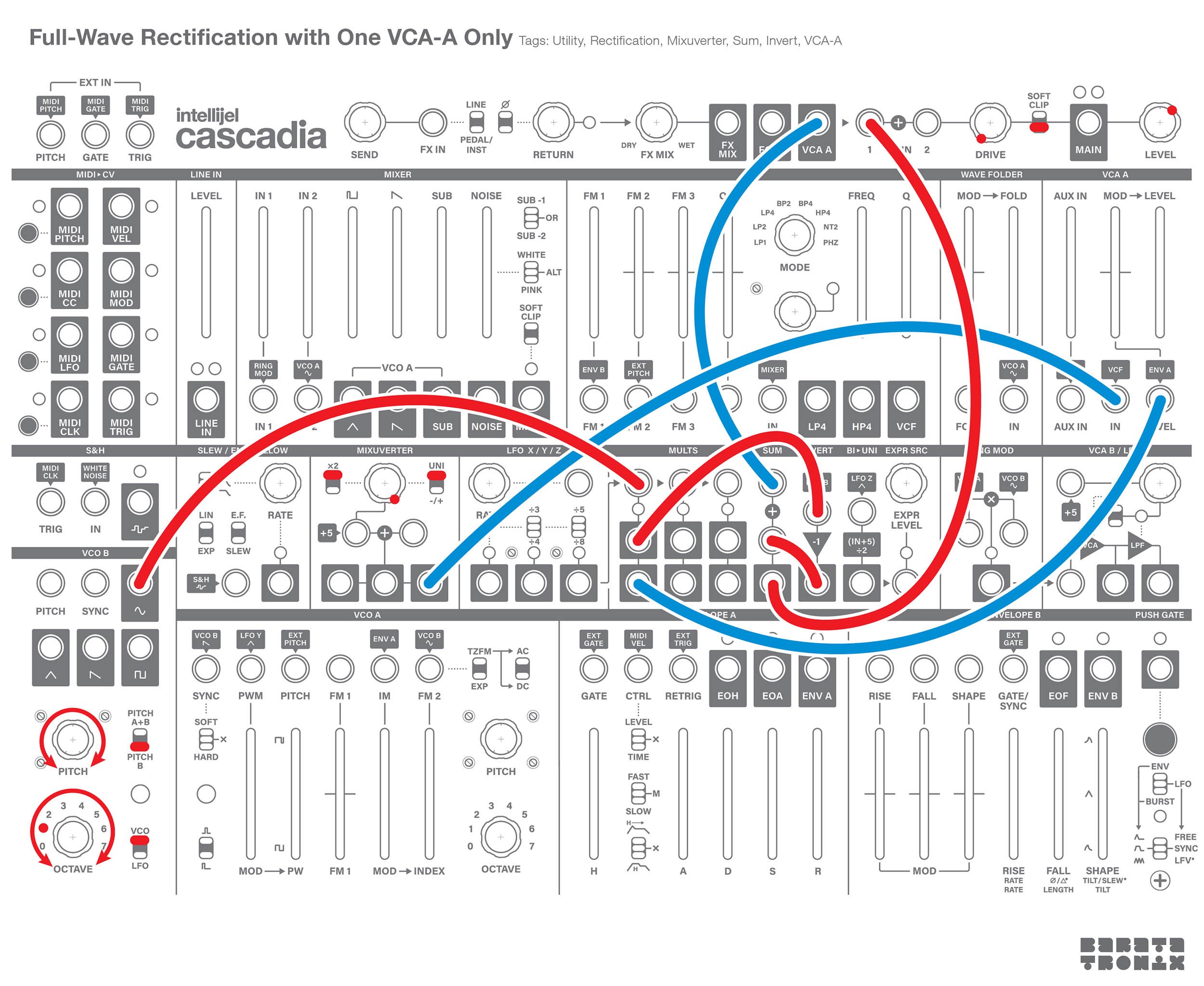
There are several ways to do this on Cascadia. The most obvious is to combine two half-wave rectified patches from here, with an inverted input on one of them. This works, but uses up both VCAs and creates quite a bit of spaghetti. Another approach is to create a single half-wave rectified signal scaled by 2x and sum that with an inverted copy of the source signal. A third way is to send two copies of the same signal into a ring mod / four quadrant multiplier.
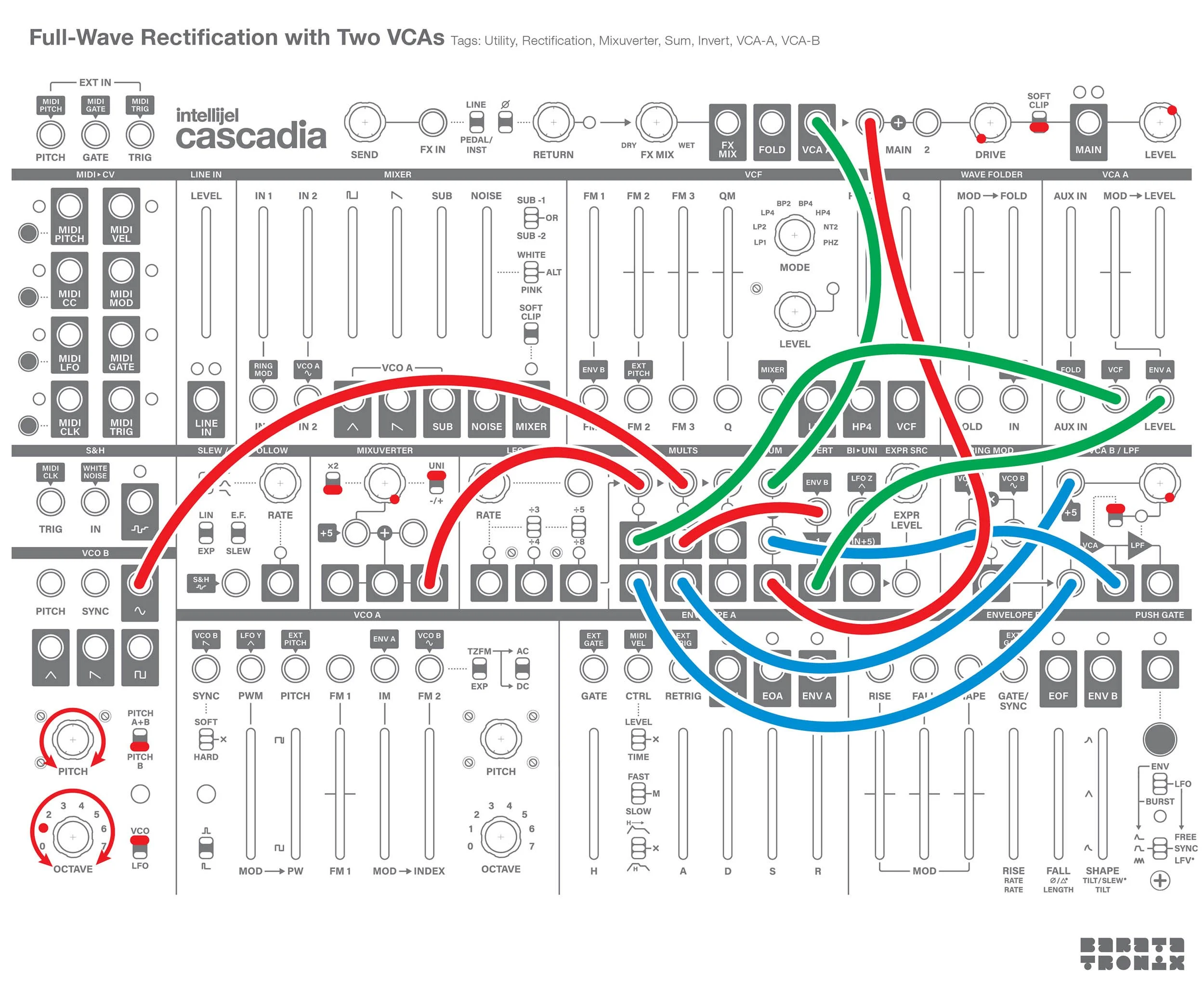
Full-Wave Rectification with Dual VCAs:
This approach combines two half-wave rectified signals where one of them has an inverted source. A VCA works by multiplying the input voltage by the CV amount. If the VCA is unipolar any part of the CV signal below 0V will be cut off. Thus, you can create a half rectified signal by patching a bipolar signal into the CV input and a control signal with the same voltage as the source signal’s peak into the VCA’s audio in. If you invert the source signal before sending it to the VCA’s CV in you will get a positive half rectified signal from the negative half of the source signal. You can then create a fully rectified signal by combining these two half rectified signals.
Patch your source signal to a multiple, and patch a copy to one of the VCA CV inputs. Then patch a second copy of the source signal to the inverter, and patch the inverter’s output to the other VCA’s CV input.
Setup the mixuverter to output a +5V control signal. Set the mixuverter’s x2 switch to the down. Turn the attenuated knob fully clockwise.
Patch the mixuverter to a mult and patch a copy to each VCAs audio input.
Patch the VCA outputs to the sum ins.
The sum output will be a full-wave rectified signal.
This works well, but usually you can achieve the same effect with a simpler patch.
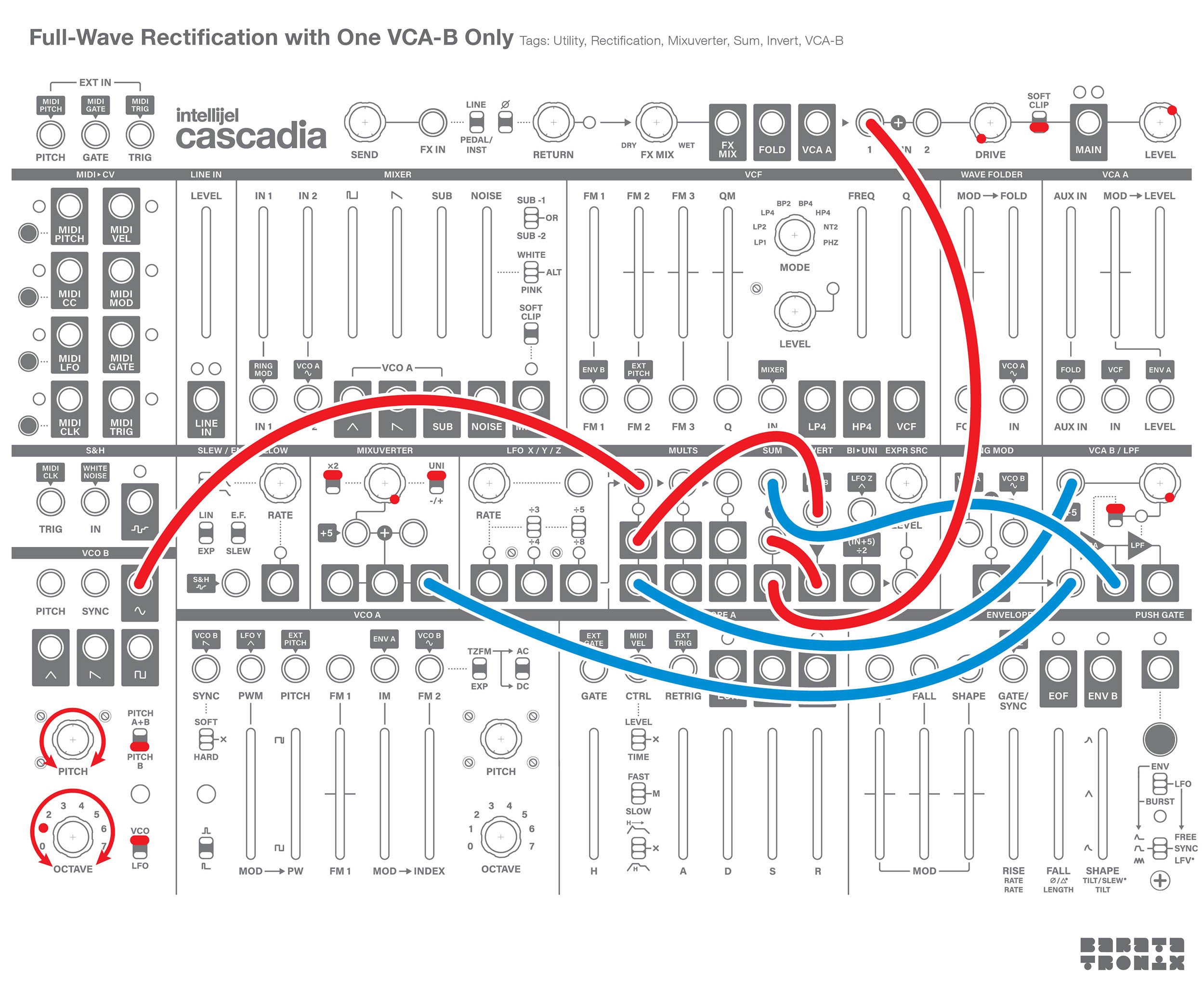
Full-Wave Rectification with One VCA:
The following will work assuming your source signal is +/-5V. Start with one of the half-wave rectified patches from here. Change the reference voltage from +5V to +10V, and then sum it with an inverted copy of the source signal.
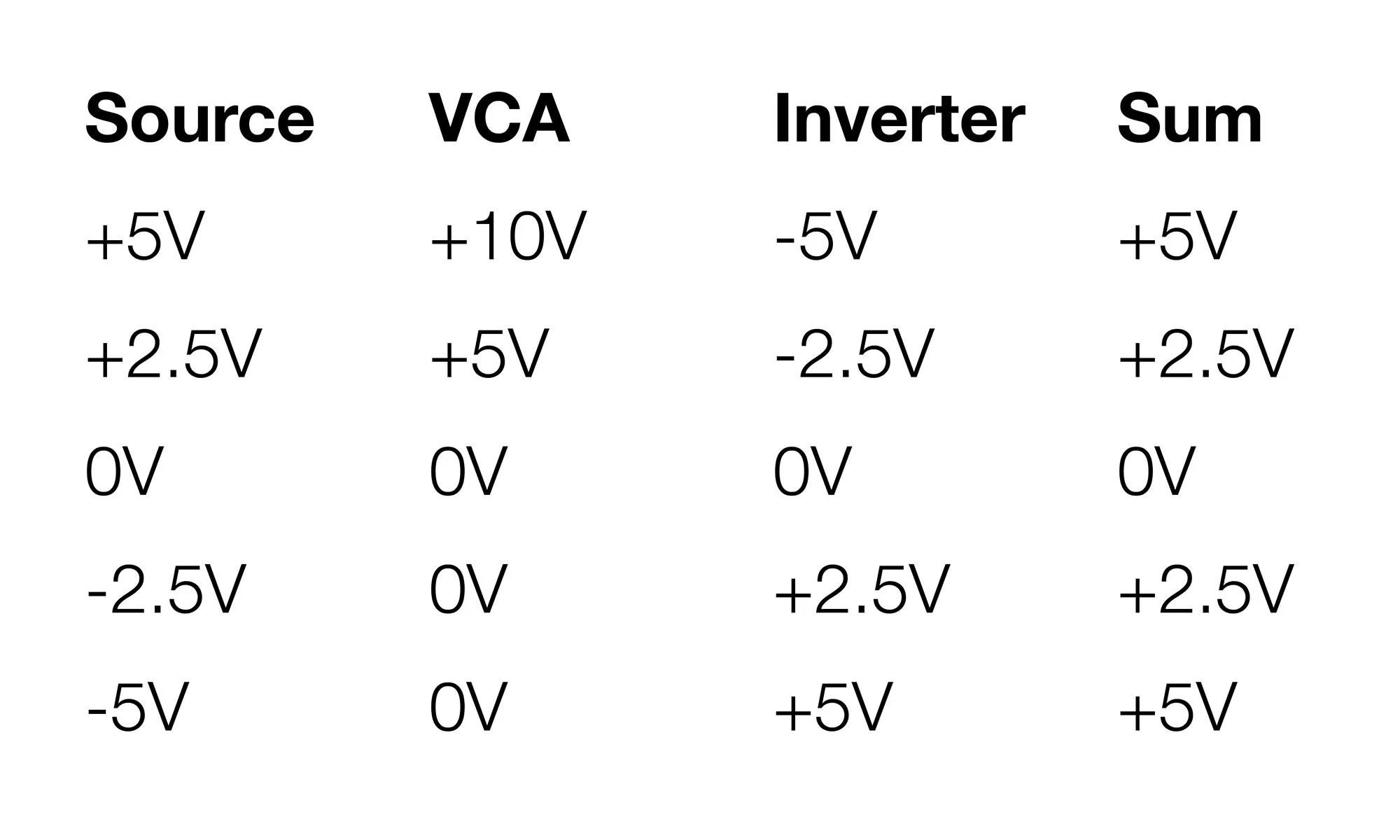
It’s easy to visualize what is going on by looking at this table.
The output from the VCA creates a half-wave rectified signal that is scaled by x2. If you use a +5V control voltage the VCA output will be at unity gain. A +10V control voltage will add a x2 scaling to the signal.
The inverter outputs (obviously) an inverted signal.
When the VCA and inverter outputs are summed, the positive portion from the VCA output is scaled back down, and the positive portion from the inverted signal are added to the zeroed out areas from the VCA output.
The result is a fully rectified signal.
The Patch:
Set the mixuverter’s x2 switch to the up position (2x).
Turn the mixuverter knob fully clockwise.
Patch from the mixuverter to the VCA-B audio in.
Patch your source signal to a mult, and send one copy to VCA-B’s CV in.
Set VCA-B’s control switch up and turn the CV amount knob fully clockwise.
Patch the VCA-B out to a sum in.
Patch a copy of the source signal to the inverter, then patch the inverter to the other sum in.
The sum out is the full-wave rectified signal.
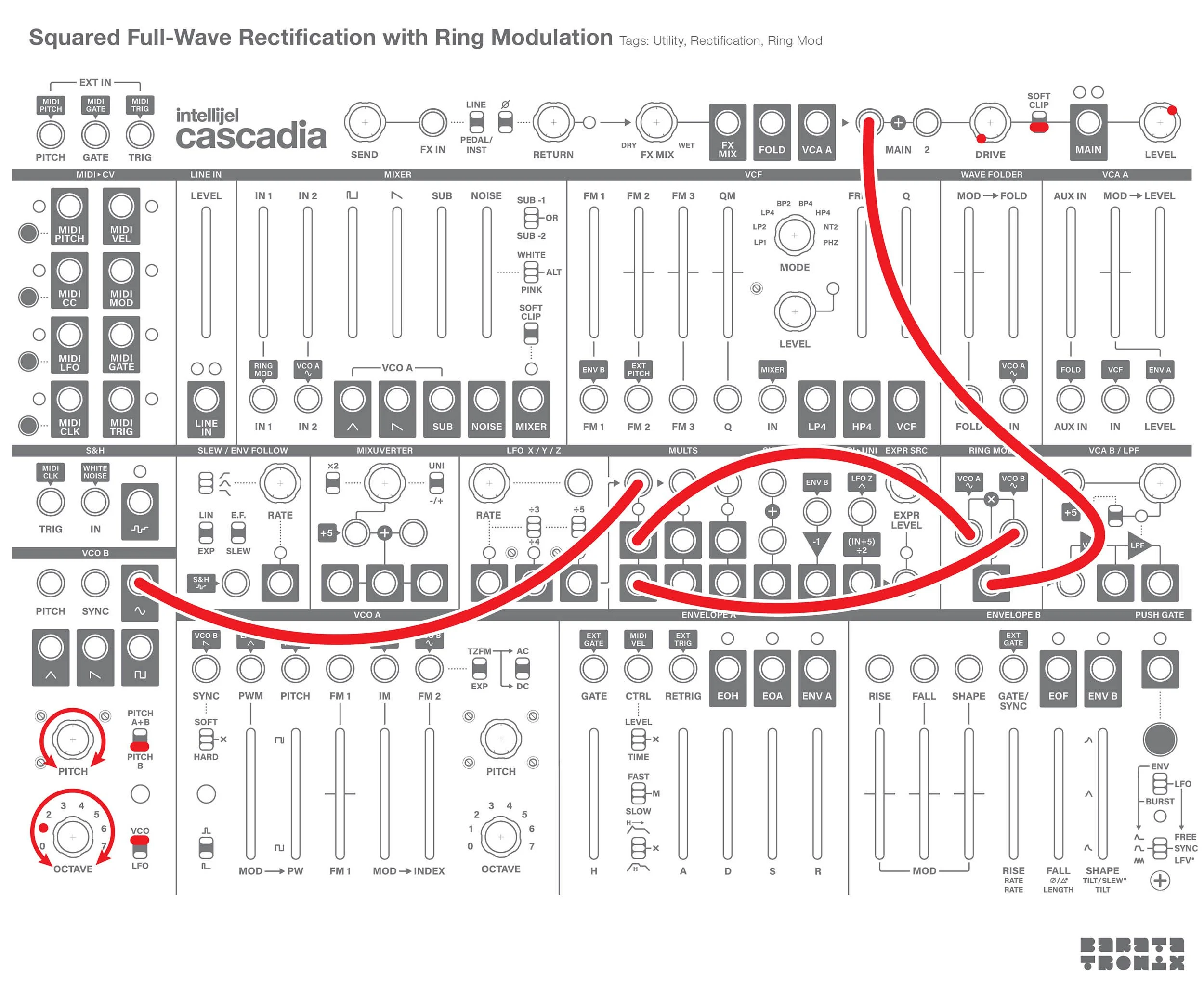
‘Squared’ Full-Wave Rectification with a Ring Modulator:
You can create a ’squared’ full-wave ratified signal similar to the squared half-wave patch found at the bottom of this page by replacing the VCA with a ring modulator / four quadrant multiplier.
The two signals are multiplied against each other, then scaled back to unity by a built in reference/scale factor (presumably 5V).
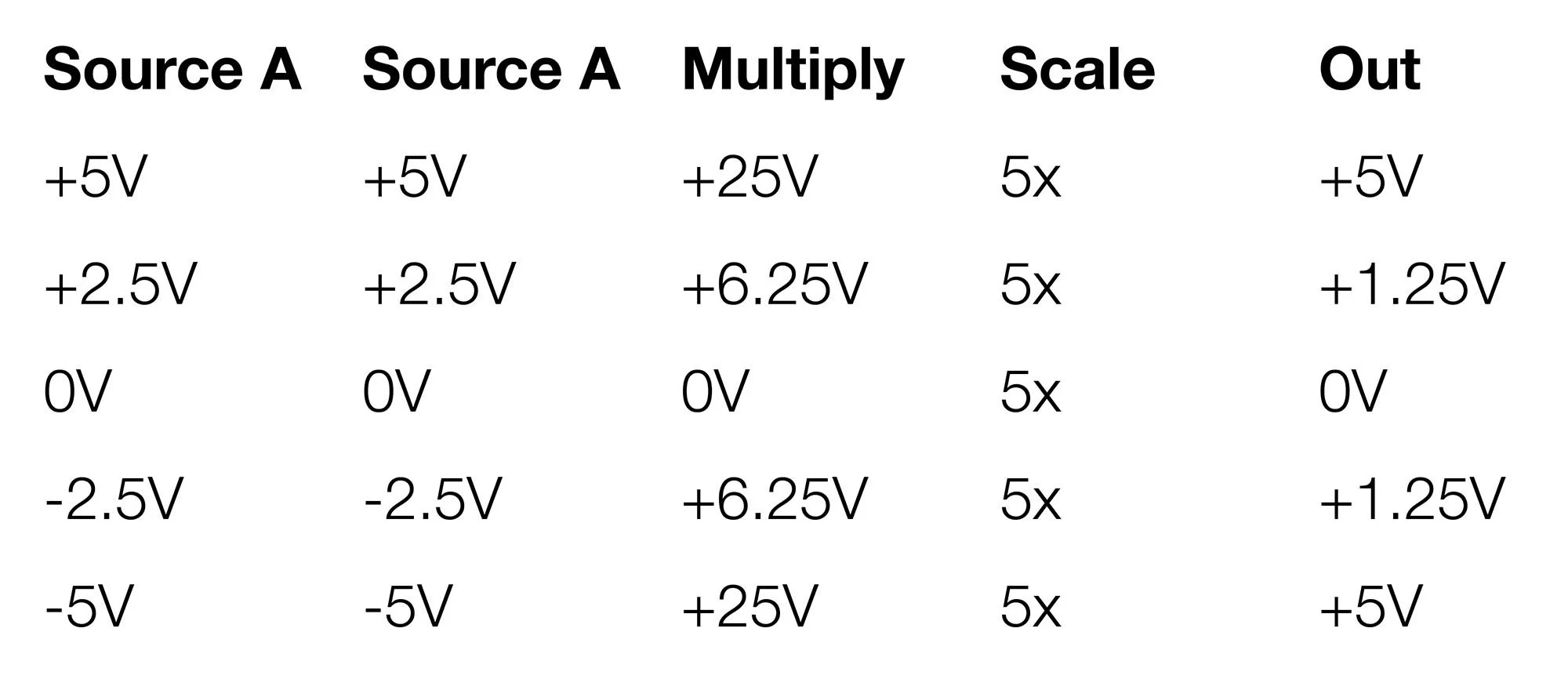
This table shows what happens, and how it’s different from full-wave rectification.
Notice how the 2.5V becomes 1.25V.
In practice this is equivalent to sending two copies of the source signal into one VCA, and two inverted copies of the source signal into another VCA, and summing the result.
Patch your source signal to a multiple. Then patch two copies of the source signal to both inputs of a ring modulator / four quadrant multiplier.